Burkina Faso, Mali, and Niger (The Alliance of Sahel States) strengthened their regional security with a single military force and convened their second AES summit in the same week, marking a historic turning point in Sahelian sovereignty.
The Alliance of Sahel States (AES) has formally established a joint military force to fight terrorism and Islamist insurgency throughout the Sahel, marking a significant step towards regional self-defence. On December 20, 2025, a ceremony was performed at an air base in Bamako, the capital of Mali, to launch the force officially.
Army General Assimi Goïta, Mali’s Transitional President, Head of State, Supreme Chief of the Armed Forces, and departing President of the AES, presided over the event.
The event was the formal handover of the Unified Force of the AES banner, marking the operationalization of a long-declared commitment by Burkina Faso, Mali, and Niger to jointly secure the sovereignty of their territories.
The Alliance of Sahel States Military Force
About 5,000 soldiers from the Alliance of Sahel States make up the recently formed force, called as the FU AES. In order to combat armed groups that have been causing instability in a significant portion of the Sahel for more than ten years, it is intended to combine air power, intelligence sharing, and coordinated ground operations.
Malian General Aliou Boï Diarra spoke to the assembly, highlighting the banner’s moral and historical significance in a highly symbolic and moving address. According to him, the banner is much more than just a ceremonial item.
“The standard that you are presenting to the unified AES force represents a memory, a will, an irreversible commitment. It profoundly affirms a certainty now deeply engraved in the hearts of our beloved peoples. This is indeed a truly historic and momentous act,” General Diarra said.
Diarra declared that the banner embodied sacrifice and struggle rather than decoration: “This sacred standard is not merely a decorative symbol. It is the profound and enduring result of precious blood bravely shed, immense courage valiantly embraced, and fundamental truth profoundly rediscovered.”
Paying tribute to the fallen, he added:
“To our cherished martyrs, to all innocent civilians, and to the brave soldiers who have fallen in battle, I humbly pay a solemn and heartfelt tribute beneath the eternal snow. They did not die in vain.”
Mali’s leader, General Goïta, in his own address, described the launch as a historic turning point for the Sahel. He began by saluting the defense leadership and troops of the region.
“On this significant occasion, I would like to extend my sincere congratulations and profoundly salute the exceptional courage, unwavering professionalism, steadfast commitment, and resolute determination of the ministers of defense, the chiefs of general staff, and especially all the brave defense and security forces of the AES area for the remarkable achievements they have made in their relentless fight against armed terrorist groups,” he said.
The AES president recalled that since the Niamey Mutual Initiative (NMI) declaration of July 6, 2024, joint military operations have already been underway, noting that they resulted in the neutralization of several terrorist leaders and the destruction of multiple insurgent sanctuaries.
According to Goïta, “All these positive results were achieved thanks to meticulous planning, timely and effective intelligence sharing, and above all the comprehensive pooling of our collective efforts and resources.”
He further announced key institutional steps consolidating the unified force, including the appointment of a new commander, the establishment of a central command post in the strategic city of Niamey, and the assignment of specialized battalions fully dedicated to AES operations. He stressed that the task ahead would require adaptability to the evolving tactics of armed groups.
“It is now critically important for the new commander not only to anticipate the increasingly complex operating methods of terrorist groups, but above all to resolutely continue this crucial fight to secure the entire Sahel region and ensure lasting peace and stability.”
General Goïta added that the conflict confronting the Sahel is multidimensional, “This war is not only military. It is also political, economic, and informational.”
He identified what he described as three major threats facing Sahelian states: armed terrorist violence, economic terrorism, and media terrorism. In response, he noted that the confederation has adopted a comprehensive strategy that goes beyond battlefield operations.
“We have taken measures to counter these threats not only by establishing this unified force, but also by creating AES Television, AES Radio, and AES print media,” he said, framing these platforms as tools to counter disinformation and psychological warfare.
The military launch follows a series of symbolic and political moves that underline the bloc’s growing autonomy. Earlier in the year, the AES unveiled a new flag, representing the confederation’s shared identity and its intention to redefine political, economic, and security cooperation outside the shadow of French imperialism and Western neoliberal frameworks. Leaders of the bloc have repeatedly criticized past military partnerships with France and other Western powers, arguing that foreign interventions failed to bring peace while undermining national sovereignty.
The AES summit
Mali hosted a summit of the Alliance of Sahel States in the same week, which concluded on Tuesday, December 23. During the summit, Burkina Faso’s leader, Captain Ibrahim Traoré, was appointed as the new head of the Alliance of Sahel States. Following the meeting, the Alliance announced that the summit would be followed by a large-scale military operation.
Earlier this year, the three countries (The Alliance of Sahel States) also introduced a joint AES passport, a major step toward deeper integration. This move came after Burkina Faso, Mali, and Niger formally withdrew from the Economic Community of West African States (ECOWAS), an organization they now openly describe as hostile.
The launch of the unified force also takes place amid rising regional tensions. Nigeria and Côte d’Ivoire, both influential ECOWAS members, have been criticized by AES leaders and their supporters for what they see as counterrevolutionary postures. In official and popular discourse within the Sahel, these countries are increasingly portrayed as attempting to contain or reverse the radical political shifts unfolding in Bamako, Ouagadougou, and Niamey.
What is clear is that Burkina Faso, Mali, and Niger (The Alliance of Sahel States) are charting a new path, one that is redefining power, alliances, and resistance in the heart of West Africa.
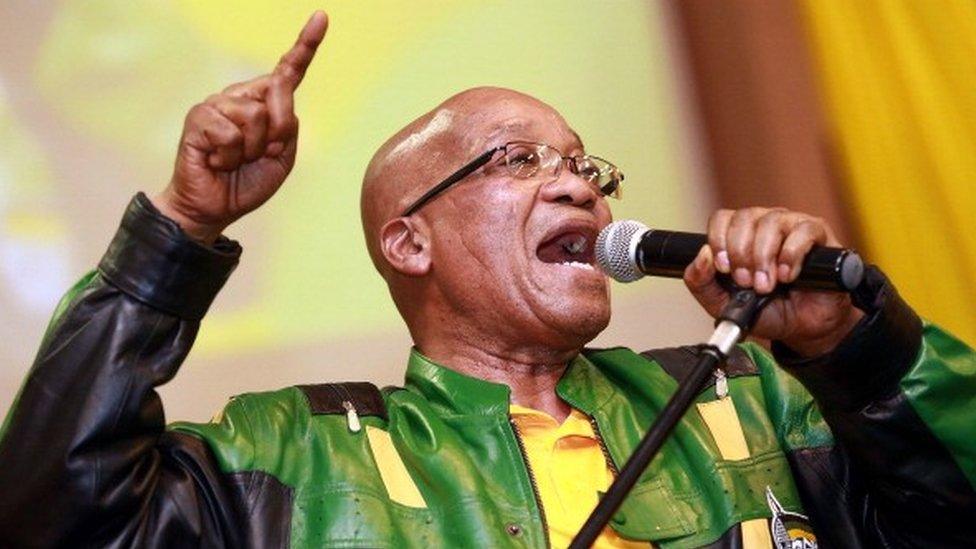
Jacob Gedleyihlekisa Zuma, widely known by his praise name Msholozi, was born on 12 April 1942 in Nkandla, a rural area in what was then northern Natal, now KwaZulu-Natal, South Africa. He was the eldest child of Nobhekisisa Zuma and his second wife, Ginamazwi, in a large polygamous household. His mother bore three sons for Zuma’s father, with Jacob being the firstborn, while his father’s first marriage produced seven children.
Zuma’s distinctive middle name, Gedleyihlekisa, was deliberately crafted by his father from a Zulu expression that loosely translates to: “I cannot remain silent when affection is offered dishonestly.” The name would later be seen by many as symbolic of Zuma’s outspoken and defiant character.
His early life was shaped by hardship. Zuma’s father, a police officer, died while Jacob was still a child. Following this loss, his mother returned with him to her ancestral home in KwaMaphumulo, where Jacob Gedleyihlekisa Zuma grew up in deeply rural surroundings. By the age of seven or eight, while many children his age were attending school, he was already tending his grandfather’s cattle. Like other young herders, he took part in traditional stick fighting, a practice in which he reportedly showed notable skill.
Formal education was largely inaccessible to Jacob Gedleyihlekisa Zuma during these years. Although his mother wished to take him back to Nkandla, the absence of a school meant he remained behind in kwaMaphumulo, caring for livestock. Eventually, his mother left for Durban to work as a domestic worker, leaving young Jacob in the countryside.
Despite these limitations, Jacob Gedleyihlekisa Zuma developed a strong desire to learn. He taught himself to read by studying the schoolbooks of other children. Demonstrating early initiative, he and a group of friends organised informal night lessons, persuading a woman who had completed Standard Four (Grade Six) to teach them. They pooled together 25 cents to pay her for the classes—an early testament to his determination and resourcefulness.
As a teenager, Zuma would occasionally visit his mother in Cato Manor (uMkhumbane), Durban. He was not permitted to enter the homes where she worked and instead wandered the city, seeking employment and observing urban life under apartheid. During this period, his political awareness deepened. Stories of the Bambatha Rebellion—recounted by elders who had lived through it—left a lasting impression on him.
An even greater influence was his elder stepbrother, Muntukabongwa Zuma, a World War II veteran who later became a trade unionist and an active member of the African National Congress (ANC). Through him, Zuma was introduced to organised resistance politics. While moving between Cato Manor and Greyville, he witnessed ANC volunteers mobilising communities, an experience that drew him directly into political activism.
By 1959, Jacob Gedleyihlekisa Zuma formally joined the African National Congress, the ANC Youth League (ANCYL), and the South African Congress of Trade Unions (SACTU). He became a regular attendee at political and trade union meetings held at Lakhani Chambers in central Durban. Between 1960 and 1963, he underwent structured political education there, laying the ideological foundation for his later role in South Africa’s liberation struggle.
Anti-Apartheid political Activities, Arrest and Imprisonment of Jacob Gedleyihlekisa Zuma
The banning of the ANC in 1960 led to the formation of its armed wing, uMkhonto we Sizwe (MK). Jacob Gedleyihlekisa Zuma soon became involved with the armed struggle, and participated in sabotage actions in Natal. As was common for aspirant MK cadres at the time, he also planned to leave South Africa for military training abroad. During this period, he came under the influence of a relative, Obed Zuma, and Stephen Dlamini and Moses Mabhida who were leading figures in SACTU. Zuma began attending evening political classes under the tutorship of Mabhida and Dlamini over a period of three years. Eventually, in 1963, Zuma was recruited as an active member of MK by Mabhida.
A plan was conceived by MK to send 45 new recruits to Zambia aboard the ‘Freedom Ferry’ for military training. Zuma was part of this group. However, the plan was uncovered by the security police who organised an operation to arrest the group. In June 1963, as the group embarked on a journey to Botswana, Zuma, alongside others, was arrested in the Groot Marico area near Zeerust, in the Western Transvaal (now North West Province).
Zuma was detained under the 90 day detention law in solitary confinement at Hercules police station before being transferred to the Hercules Police Station near Pretoria. He was interrogated and beaten, even though the police already had enough evidence to secure a conviction. Thereafter, he was held in solitary confinement for 90-days. The trial was held at the Pretoria Old Synagogue with Judge Fritz Steyn, presiding.
On 12 August 1963, Zuma, at the age of 21, was convicted and sentenced to 10 years in prison for conspiring to overthrow the government. Along with some of his comrades, he was taken from Pretoria to Leeukop Prison outside Pretoria before being transported to Robben Island to serve his sentence. The vehicle stopped for an overnight sleep in Colesberg to collect other prisoners. It was here that Zuma met his long-time friend Ebrahim ‘Ebie’ Ebrahim. The handcuffed prisoners were also placed in leg irons for the entire journey, in a windowless van, with just a sanitary bucket for comfort.
Robben Island
Jacob Gedleyihlekisa Zuma entered Robben Island on 30 December 1963, sharing a communal cell with a group of between 30 and 50 other prisoners, washing in cold water (prisoners only got hot water in 1973) and eating boiled mealies (maize) three times a day. African prisoners were given a different diet from the Coloured and Indian prisoners on the island. For the ten years that he was on Robben Island, Zuma never received a single visitor. His mother, on her domestic worker’s salary, was scarcely able to afford the fare. Cognisant of this fact, Jacob Gedleyihlekisa Zuma wrote to her, telling her to rather keep her income to look after his brothers and sisters.
Together with other prisoners on the island, Jacob Gedleyihlekisa Zuma worked in the blue stone quarry digging and crushing slate for the construction of more prison cells. He was among the prisoners from Natal who initiated political study groups. He also served in a number of positions in ANC structures, which included being a group leader, a Public Relations Officer, cell leader and Chairman of the Political Committee, organising political discussions. After prisoners fought for more rights in prison, sport was eventually permitted.
Zuma took advantage of this new dispensation and played soccer whenever he could; he even became captain of the Rangers, the Robben Island team for which he played. He was also part of a choral and traditional dance group, as well as playing table tennis and chess and participating in athletic events on the island.
Release, Resumption of political Activities and Exile
On Jacob Gedleyihlekisa Zuma’s release on 29 December 1973, he was taken to Pietermaritzburg police cells where he was detained for another two weeks before being taken to Nkandla, where he was eventually released. After his release, Phyllis Naidoo, an attorney in Durban who was herself later banned and forced into exile, found work for Zuma in a pet shop in Durban. However, behind the scenes, Zuma resumed his political activities. He was, for instance, instrumental in the re-establishment of ANC underground structures in Natal between 1974 and 1975, where he helped to provoke industrial unrest, aiding some 160 000 workers there to go on strike.
During this time, he also became part of an initiative, led by Harry Gwala, to recruit and send young people out of the country for military training. His primary responsibility was to ensure a safe passage for recruits into Mozambique and their re-entry into South Africa, with weapons and further instructions from the MK leadership in exile.
In his private life, Jacob Gedleyihlekisa Zuma took advantage of being free from jail by marrying his childhood sweetheart, Sizakele Gertrude Khumalo in 1973. However, following Harry Gwala’s arrest at the end of a workers’ strike in 1975, Jacob Gedleyihlekisa Zuma left the country for Swaziland that December. His new wife decided not go with him, preferring instead to wait for his return as she had done while he was in prison on Robben Island. Their marriage did not survive the separation.
Over the next few years, Jacob Gedleyihlekisa Zuma was based first in Swaziland and then Mozambique. In Swaziland, he met with other ANC comrades, among whom, future President Thabo Mbeki, who allegedly first taught Zuma how to use a gun..
Early in 1976, Jacob Gedleyihlekisa Zuma secretly entered South Africa to re-establish contact with activists in the Durban area. Then, in March 1976, along with Thabo Mbeki and Albert Dlomo, Zuma was arrested and held at the Matsapha prison in Swaziland but managed to avoid deportation. Two other ANC members were, however, kidnapped from Swaziland and imprisoned in South Africa. After the intervention of Oliver Tambo, who sent Moses Mabhida and Thomas Nkobi to assist, Zuma, along with his comrades, was released in April 1976 and deported to Mozambique, where he first served as the official ANC Deputy Chief Representative and later the Chief Representative.
During this period, Jacob Gedleyihlekisa Zuma was involved in underground work with Thabo Mbeki and others, supporting ANC structures operating mainly inside South Africa. Zuma was deployed to work largely within the Natal machinery. Later, whilst in Mozambique, Zuma dealt also with the thousands of young people that left South Africa after the Soweto uprising in June 1976. However, Zuma’s work remained largely focused on the internal underground of the ANC.
After the formation of the Internal Political Reconstruction Committee (IPRC) in Mozambique, in 1977, Jacob Gedleyihlekisa Zuma, Indres Naidoo and John Nkadimeng were drafted into the ANC Maputo Regional Committee. Zuma was also co-opted as a member of the ANC National Executive Committee (NEC) in 1977. That same year, Zuma began working for the SACP, and in 1978 completed a three month leadership and military training course in the Soviet Union.
By 1984, Jacob Gedleyihlekisa Zuma had been elected the Deputy Chief Representative of the ANC, the year the Nkomati Accord was signed between Mozambique and South Africa. After this accord was signed, Zuma was appointed as Chief Representative of the ANC and remained in Mozambique. He was re-elected to the ANC’s NEC at the Kabwe Conference in 1985. Zuma also served on the ANC’s Military and Political Committees after its formation in the mid-80s, and the Intelligence Department at the ANC Head Office in Lusaka, Zambia.
By 1986, Jacob Gedleyihlekisa Zuma commanded the Mandla Judson Kuzwayo (MJK) unit while he was still in Mozambique. Headed by Yunis Shaik (Mandla), together with his brother Moe Shaik (Judson) and Jayendra Naidoo (Kuzwayo), the unit infiltrated the Security police in Durban and were able to access information relating to informers that the Security Police used. Due to this, the South African government requested Mozambican authorities to expel six senior members of the ANC from Mozambique, including Jacob Zuma. In response, the ANC moved him to Lusaka, Zambia where he was appointed the Chief of Intelligence Department.
Along with Mbeki, Jacob Gedleyihlekisa Zuma formed part of the ANC President, Oliver Tambo’s negotiation team, which met with the South African government representatives in the late 1980s to early 1990s.
Among the first of these meetings, in November 1987, Zuma, together with Mbeki, was present at a meeting arranged by Professor Willie Esterhuyse and a few of his colleagues. Several similar meetings would follow where Zuma would participate.
Return to South Africa
After the ANC was unbanned in February 1990, Jacob Gedleyihlekisa Zuma clandestinely returned to the country in March, alongside Penuell Maduna and Mathews Phosa, to work as part of a steering committee tasked with identifying remaining obstacles to negotiations between the government and the ANC. Later he was involved in negotiations which resulted in the signing of the Groote-Schuur Minute, an agreement that outlined important decisions regarding the return of exiles and the release of political prisoners.
Subsequently, in August 1990, when Mandela, Mbeki and Zuma were abroad, Cyril Ramaphosa, then the Secretary General of the ANC convened the ANC’s National Working Committee (NWC) axed Zuma from his position as head of intelligence and replaced Mbeki as head of the ANC’s negotiations with the Government. Nonetheless, in November 1990, Jacob Gedleyihlekisa Zuma was elected Chairperson of the ANC’s Southern Natal region.
In 1991 Zuma, together with Frank Mdlalose, national Chair of the Inkatha Freedom Party (IFP), set up the Peace and Reconstruction Foundation to rebuild the devastation following internecine battles between the ANC and the IFP. He is largely credited with weakening the IFP’s grip on power in kwaZulu-Natal and the diminishing support for the party.
In December 1991, at the first ANC conference held in South Africa since 1959, Zuma was elected Deputy Secretary General and attended the Convention for a Democratic South Africa (CODESA), where he served as the chair of the ANC’s negotiations commission. By the end of 1990, Zuma had left the SACP as a member, dedicating himself fully to the ANC.
In 1993 the ANC set up the Motsuenyane Commission to investigate human rights abuses that occurred in ANC detention camps from 1979 to 1991. It was chaired by Dr. S.M. Motsuenyane, and assisted by two other commissioners, the Hon. Margaret Burnham and Advocate D.M. Zamchiya. The Commission reported that the ANC was guilty of torture in its camps and that specific individuals were responsible for these abuses. The Commission was not happy with Zuma’s explanation of events that took place and condemned him for not exercising proper supervision.
Another controversy with which Jacob Gedleyihlekisa Zuma’s name was connected was in relation to the death of Muziwakhe Ngwenya (MK name -Thami Zulu – TZ) in 1989. Whilst there was no direct reference to Zuma in the hearing, he was implicated in Zulu’s death. The ANC had asked the Truth Commission to help uncover whether former MK Commander Thami Zulu was an “enemy agent”. The Commission had already been approached by Zulu’s family to help find the truth behind his 14-month detention in exile under suspicion of being a spy, and his death a week after his release. In its written submission to the Commission, the ANC said Zulu, who had AIDS, had died of poisoning after his release, “and to this day it is a matter of conjecture as to who administered this poison and why this was done”. They went on to add that “[t]he (ANC’s) Department of Intelligence and Security has reason to believe that an agent or agents of the regime were responsible.”
Mbeki said an ANC internal Commission of Inquiry into Zulu’s case had not made any conclusive finding about this. The ANC Commission’s report was among the documents provided to the TRC in an appendix to the party’s written submission. Mbeki denied that Zulu had been kept in an ANC detention centre under suspicion of being a spy. Mbeki also denied claims made by Zulu’s family to the commission that it had not been informed of the circumstances of Zulu’s detention and death in exile.
The family had visited Lusaka twice, paid for by the ANC, and had been given the post-mortem report and other information. “He was never charged with being an enemy agent, nor was such a charge pending. Even if he was released on medical grounds, the fact is that once he was set free his status was the same as that of any other member of the ANC. In short, there was no irrefutable proof that Zuma was in any way responsible or linked to Zulu’s death, yet the accusation had been made.
Another incident where Jacob Gedleyihlekisa Zuma was prominently involved related to a former police officer, Butana Almond Nofomela, who was due to hang for the murder of a farmer in 1989. On the eve of his execution he asked to speak to Lawyers for Human Rights. Nofomela gave an affidavit stating that he was part of a state assassination squad (based at Vlakplaas) and that he had been involved in the murder of leading political figures in the resistance movement. He won a reprieve. Journalist Jacques Pauw on the Vrye Weekblad broke the exclusive story, which Dirk Coetzee, a former commander of the hit squad based at Vlakplaas, confirmed. Coetzee agreed for the story to be published on condition that the ANC protect him. The ANC agreed.
Jacob Gedleyihlekisa Zuma was placed in charge of this project. In the meantime Coetzee’s wife embarked on an affair with another Security Police plant. Coetzee was furious to learn about this whilst in Lusaka. Zuma arranged for Coetzee’s wife to be flown to Lusaka to help save the marriage, and Coetzee was always grateful to Zuma for this act of kindness.
In January 1994, Jacob Gedleyihlekisa Zuma was nominated as the ANC candidate for the Premiership of Natal. This did not materialise since the ANC lost to the IFP in the provincial elections. Later that year, Zuma was appointed MEC of Economic Affairs and Tourism for the KZN provincial government, a position he would hold until June 1999.
Following the 1994 general elections, at the ANC’s national conference, held in Bloemfontein, Zuma was elected both Chairman of the party and Chairperson of the ANC in Natal. An exception was made in the ANC constitution to allow Jacob Gedleyihlekisa Zuma to hold both positions.
He was also one of the people who suggested Mbeki’s name for the position of the country’s Deputy President.
Five years later, at the ANC’s National Conference held at Mafikeng in December 1997, Zuma was elected as the ANC’s Deputy President. In 1999 he was appointed as the Deputy President of South Africa, a position he held until he was relieved of duties by then state president Thabo Mbeki in June 2005.
Ascendancy to Power
On 18 December 2007, Jacob Gedleyihlekisa Zuma was elected as President of the ANC at the party’s 52nd national conference in Polokwane, Limpopo. Zuma polled 2 329 votes against his opponent, Mbeki, who received 1 505 votes. In his closing address to the conference, Zuma stressed the unity of the organisation as being paramount. He also paid tribute to Mbeki and the work that he had done over the years for the ANC and the country. This meant, in effect, that for a brief period, Mbeki retained the office of state President, but Jacob Gedleyihlekisa Zuma was the President of the ANC.
After Jacob Gedleyihlekisa Zuma’s election, the National Prosecuting Authority (NPA) served him with an indictment on charges of corruption, fraud and money laundering. On 12 September 2008, Judge Chris Nicholson, sitting in the Pietermaritzburg High Court, held, inter alia, that the corruption charges were unlawful on procedural grounds. Mbeki applied to the Constitutional Court to appeal the Nicholson verdict, which the NPA opposed. Zuma also stated that he opposed Mbeki’s application.
On 20 September 2008, the ANC NEC resolved to recall Thabo Mbeki as head of state. He was replaced by Kgalema Mothlante who became the third president of the Republic of South Africa. He held office for approximately 7 and a half months (between 25 September 2008 and 9 May 2009). The NPA later withdrew all 16 charges (of racketeering, corruption, fraud and tax evasion) against Zuma in the Durban High Court on 6 May 2009, paving the way for Jacob Gedleyihlekisa Zuma to make a push for the office of state President.
After the charges were withdrawn, Jacob Gedleyihlekisa Zuma was elected President of the Republic of South Africa on 6 May 2009. He was inaugurated at the Union Buildings in Pretoria on 9 May 2009, stating at the time that he would prefer to serve just one term as President. In the event, however, he ran for the position twice, winning the majority of the national vote on both occasions.
Zuma’s first term in the Presidency ran from 2009- 2014, during which time, Zuma’s long-time acquaintance and former financial advisor, Schabir Shaik was released from jail on medical parole, just 28 months into his 15 year jail sentence. This fueled speculation that the new President may have had a hand in negotiating his release, especially in light of comments Zuma had made prior to Shaik’s release indicating publicly that he would personally oversee Shaik’s acquittal. He also took over from Thabo Mbeki as mediator in resolving the Zimbabwe political crises under the banner of Southern African Development Community (SADC).
On 14 January 2014, the ANC announced that Zuma would be their only candidate for the upcoming general elections. On 21 May that year, Zuma was again elected as President of the Republic, beginning a second term.Jacob Gedleyihlekisa Zuma’s next stint as Head of State continued in similar fashion, with more controversy seemingly following his every move. In February 2016 then Public Prosecutor, Thuli Madonsela, found Zuma guilty of having exceeded his powers of office by using state funds to upgrade his Nkandla homestead and ordered him to pay back R7.8 million (see below).
Socio-Economic Policy Changes under Zuma
In 2010, Zuma announced the adoption of the New Growth Path (NGP) during his State of the Nation address. The NGP replaced the ASGISA initiative which was introduced under Mbeki as the principal economic policy driver for South Africa.
Subsequently, at the Mangaung conference in 2012, the National Development Plan (NDP) was endorsed by the ANC and adopted as the long term strategic vision and blueprint for socio-economic development for the country. The NDP sets out the goals the country plans to achieve by 2030, builds consensus on the key obstacles to achieving these goals and what should be done to overcome those obstacles, as well as providing a shared long term strategic framework that allows for more detailed and effective planning and creates a basis for deciding how best to use limited resources.
The realisation of the vision elucidated in the NDP has been hampered by the fact that certain underlying assumptions, especially those around economic growth, have not been realised. The ANC has stated that it will be reviewing the NDP at its 2017 policy conference.
In 2015, during his State of the Nation address, Jacob Gedleyihlekisa Zuma unveiled his Nine-Point Plan, aimed at boosting economic growth and creating jobs in the medium term. The plan’s components included:
1. Resolving the energy challenge;
2. Revitalising agriculture and the agro-processing value chain;
3. Advancing beneficiation or adding value to the mineral wealth;
4. More effective implementation of a higher impact Industrial Policy Action Plan (IPAP); 5.Encouraging private sector investment;
6. Moderating workplace conflict;
7. Unlocking the potential of SMMEs, cooperatives, townships and rural enterprises;
8. Boosting the role of state-owned enterprises, ICT infrastructure and broadband rollout, water, sanitation and transport infrastructure;
9. Operation Phakisa, aimed at growing the ocean economy and other sectors.
In September 2016, when answering questions in Parliament, Zuma appeared unclear on the plans points, responding to a question posed by an opposition MP by saying “We’ve talked about it many times in this Parliament. The honourable speaker is very much aware of the 9-point plan, we’ve talked about that. One of them is agriculture. There are many.”
Combatting HIV/AIDs and other health gains
Life expectancy in South Africa has risen from 56.8 years in 2009 to 62.4 years in 2016 according to mid year estimates generated by Statistics SA. This improvement is largely attributable to changes in government policy under Jacob Gedleyihlekisa Zuma on combatting TB and HIV/AIDs. Policies in this regard have included improving access to and uptake of ARVs as well as a widespread HIV Counselling and Testing campaign. This ARV rollout has also had significant impact on the infant and child mortality rates, by reducing mother-to-child transmissions.
Under Jacob Gedleyihlekisa Zuma’s administration, discussion around the introduction of National Health insurance has been ongoing, and a regulatory body has been set up to regulate compliance with norms and standards. The Office of Health Standards Compliance includes within its auspices the Health Ombud, and the first Ombudsman, Professor Malegapuru Makgoba, was appointed on 1 June 2016. His report on the death of psychiatric patients moved out of the Life Esidimeni Hospital by the Gauteng Health Department served as a scathing indictment of the apparent cost-saving measures adopted by the Department that resulted in the deaths of at least 94 people. The report concluded that the decision was “fundamentally flawed, irrational, unwise and inhumane”.
Nkandla homestead and other controversies
Jacob Gedleyihlekisa Zuma’s second term in the President’s Office has seen him embroiled in a number of polemic issues. One major controversy relates to costly upgrades to his private home in Nkandla, kwaZulu-Natal. Mail & Guardian journalists, Mandy Rossouw and Chris Roper accidentally stumbled on the Nkandla development in November 2009 while on a story in Nkandla. It was the late Rossouw who noticed the construction works and managed to get into the building area. She wrote a story which was quite a scoop.
In May 2009, a security assessment of Jacob Gedleyihlekisa Zuma’s Nkandla residence in kwaZulu-Natal was done by state security. State security personnel recommend improvements of around R27.9m. By June 2010, R77m from other programmes had been directed to the Nkandla security upgrades. These programmes included plans for city regeneration.
There was approval for R38.9m in 2010/11 but this is still subject to some controversy as to who actually approved this amount. By 2013, reports revealed that R203m of taxpayers’ money would be used in the revamping of the building. Public outrage ensued, with government issuing reports that impropriety was involved. On 1 October 2012 the Minister of Public Works, Thulas Nxesi issued a statement on the Nkandla Presidential Residence:
“Please be advised that Nkandla Presidential Residence, like all other presidential residences in South Africa, is declared a National Key Point in terms of the National Key Point Act 102 of 1980 (“the Act”). Therefore, any information relating to security measures of a National Key Point is protected from disclosure in terms of the Act, the provisions of the Protection of Information Act, the Minimum Information Security Standards (MISS) and other relevant security prescripts of the State Security Agency.”
In October 2012, the Public Protector Thuli Madonsela began an investigation into the publicly funded construction at Nkandla. Jacob Gedleyihlekisa Zuma addressed Parliament in November 2012 and claimed that the costs of Nkandla upgrades are due to the National Key Points Act. He further claimed that his family paid for the costs of the building. The state then filed a court order to prevent Public Protector Thuli Madonsela from releasing her report on Nkandla. Nonetheless, Madonsela was within the law and released her 450 page long and a 75-page executive summary report entitled Secure in Comfort, on the controversial upgrades to President Jacob Gedleyihlekisa Zuma’s Nkandla homestead. Madonsela said Zuma must pay for the non-security upgrades at his home, which included a visitors’ centre, an amphitheatre, a swimming pool, a cattle kraal, a culvert, a chicken run and extensive paving.
There was immense public outrage and opposition parties were united in their condemnation of the “Nkandla saga”. For example, the Democratic Alliance called for the impeachment of Zuma. According to Madonsela’s report the final costs of Nkandla are “conservatively estimated” to amount to R246m, but could be higher. Recent newspaper articles claim that the costs maybe closer to R266m.
In the second half of 2014, the Economic Freedom Fighters [EFF] began to challenge Zuma in Parliament on the Nkandla question, demanding that he respond to Parliament on questions about the payments for Nkandla. In August of 2014 the EFF began to use the slogan, ‘pay back the money’ in response to Zuma’s unwillingness to speak on the Nkandla scandal.
President Jacob Gedleyihlekisa Zuma’s State of the Nation Address (SONA) on 12 February 2015 was marked by one of the most controversial breaches of Parliamentary law in recent South African history. Prior to the address, the EFF had been agitating the Zuma should ‘pay back the money’ spent on Nkandla and had warned that they were going to bring up the Nkandla question during Zuma’s State of the Nation address.
During Jacob Gedleyihlekisa Zuma’s speech to Parliament a member from the EFF began to raise points of order. Members of the EFF were subsequently asked by the Speaker to leave Parliament, but they refused to do so arguing that they had the parliamentary right to raise a point of order during any parliamentary session. The Speaker then asked security officers to enter the building and the EFF members were forcefully removed from Parliament. In response to the belief that some of the security personnel were undercover policemen and the severe breach of parliamentary law in allowing for members to be forcefully removed from Parliament, the opposition DA party also walked out of Parliament in protest. This incident, coupled with an attempt to jam the signals of reporters in Parliament cast a dark shadow over President Zuma’s 2015 State of the Nation address.
In Parliament debate continued for days over the occurrences at SONA with many Parliamentarians standing up to speak against Zuma and the actions of his government on the day. The leader of the DA, Mmusi Maimane, went so far as to tell Zuma, ‘you broke Parliament’.
On 19 February 2015, Zuma responded to Parliament on the accusations and questions around his State of the Nation Address. In this address Zuma began by stating that 2015 was ‘the year of going the extra mile in building a united, democratic, non-racial, non-sexist and prosperous South Africa. It is also the year of rededicating ourselves to eradicate racism and all related intolerances in our country.’ On the issue of the signal jamming Zuma said it was ‘an unfortunate incident and it should never happen again’.
Uproar on Teen Pregnancy Statements
In late March 2015 President Jacob Gedleyihlekisa Zuma once again found himself at the centre of controversy when in an annual address to traditional leaders, Zuma argued that teen mothers should be separated from their children until they had finished school. He told the leaders, ‘they must be educated by government until they are empowered and they can take care of their kids, take them to Robben Island or any other island, sit there, study until they are qualified to come back and work to look after their kids.’ Jacob Gedleyihlekisa Zuma acknowledged that his statements would cause controversy, but he felt that allowing teenage mothers to leave school in order to look after their children was proving an untenable burden on society and the state’s welfare bill.
Jacob Gedleyihlekisa Zuma further stated, ‘in no way can you have young kids being mothers of other kids and young boys being fathers of kids, They know nothing of it.’ Zuma’s statements caused a furore, especially amongst women’s rights activists who saw Zuma’s statements as an attack on women and the rights of young teenage mothers. In response to the furore, President Zuma’s office issued a statement which read that ‘President Zuma was emphasising the need for teenagers to focus on their studies and said children should not be raising children’.
Court cases
During his tenure as Deputy President of South Africa, Jacob Gedleyihlekisa Zuma was also involved in controversies, which resulted in major legal problems. In 2002, Zuma was implicated in a major corruption scandal, in connection with the trial of his close associate Schabir Shaik.
The state alleged that Jacob Gedleyihlekisa Zuma used his position in government to enrich himself by benefitting from Shaik and companies involved in the procuring of arms for the state. It was further alleged that he violated ‘The Code of Conduct in Regard to Financial Interests’ to which all cabinet members are bound. In Shaik’s court case, Judge Hilary Squires said that Shaik, Zuma and Alain Thetard – the local director of an arms company involved, Thomson (later Thint) – met in Durban and agreed that Jacob Gedleyihlekisa Zuma would receive R500 000 a year in return for protecting the arms company from any investigation regarding its role in the arms deal acquisition, which became a serious issue for the country. Bulelani Ngcuka, then National Director of Public Prosecutions and Maduna, then Minister of Justice announced at a media conference that the National Prosecuting Authority’s (NPA) decision was not to prosecute Zuma for corruption; however Shaik was to be charged for fraud and corruption.
Ngcuka had said that although Jacob Gedleyihlekisa Zuma was clearly involved, the NPA did not have a winnable case against Jacob Gedleyihlekisa Zuma. Shaik at his trial said that the financial relationship between Zuma and himself were loans made in friendship and not as a result of corruption. He had realised that Zuma was experiencing severe financial difficulties. Nevertheless, on 2 June 2005, Shaik was convicted at the Durban High Court on two counts of corruption and one of fraud relating to bribes he allegedly paid to influence Jacob Gedleyihlekisa Zuma in order to win government contracts for Shaik’s company, Nkobi Holdings.
On 6 November 2006, the Supreme Court of appeal (SCA) in Bloemfontein, Free State Province upheld Shaik’s fraud and corruption charges and he was set to begin his 15 year sentence at Durban’s Westville Prison. The five SCA judges agreed with Judge Squires findings that Shaik had made 238 payments to Zuma totalling R1.2 million and that it was not because of their friendship.
On 14 June 2005, President Mbeki relieved Zuma of his duties as Deputy President of the country, but he remained Deputy President of the ANC. This, in a sense, divided the ANC and there was groundswell of support for Zuma. At a meeting of the ANC’s leaders, Jacob Gedleyihlekisa Zuma offered to step down to clear his name, a move which was accepted. However, this was overturned by delegates at the ANC’s National General Council (NGC). However, he resigned his parliamentary seat, almost immediately after the sacking, although as an elected person he could have opted to stay on. On 20 June 2005, Vusi Pikoli, the National Director of Public Prosecutions who succeeded Ngcuka, announced through his spokesperson, Makhosini Nkosi that Jacob Gedleyihlekisa Zuma would be charged with corruption.
On 29 June 2005, Zuma appeared in the Durban Magistrates Court on two counts of corruption, including bribery related to attempting to influence an investigation into the 1999 arms deal. He was released on R1000 bail. Nonetheless, Zuma’s legal woes increased. On 8 August 2005, Aubrey Thanda Mngwengwe, the acting investigating director of the Directorate of Special Operations (DSO or Scorpions) decided to extend an investigation to include fraud in connection with Zuma’s declarations to the Registrar of Parliamentary Members Interests and the South African Revenue Services (SARS) for benefits he received from Shabir Shaik.
On 20 September 2006 Judge Herbert Msimang struck the corruption case against Jacob Gedleyihlekisa Zuma in the Pietermaritzburg High Court in kwaZulu-Natal on the grounds that the State had charged Zuma before properly investigating and preparing its case against him.
Further controversy arose in November 2005, when Zuma was accused of raping Fezekile Ntsukela Kuzwayo, on 2 October 2005 at his Forest Town, Johannesburg home. Fezekile was known as Khwezi during and after the trials (it is illegal to publish the names of a rape complainant). Fezekile’s father and Zuma were both members of MK and served prison sentence together on Robben. Fezekile laid a charge on 4 November at the police station in Hillbrow, Johannesburg. Questions arose whether then Minister of Intelligence, Ronnie Kasrils, had a hand in Fezekile laying a charge against Zuma, which Kasrils has denied, despite the fact that Fezekile did speak to Kasrils before she laid her complaint at the police station.
Jacob Gedleyihlekisa Zuma informed the ANC NEC that allegations of rape had been made against him, but issued a denial through his lawyer Michael Hulley. He went on trial on 13 February 2006. Judge President of the Transvaal Provincial Division, Bernard Ngoepe withdrew on the grounds that Zuma’s legal team asked for his recusal as he had signed the warrant in 2005 to search Zuma’s homes. Judge Phineas Mojapelo recused himself on the grounds that he had worked with Zuma during the days of the struggle. Ngope’s Deputy, Judge Jeremiah ‘Jerry’ Shongwe was the brother of Minah Shongwe, the mother of one of Zuma’s children Edward.
The Judge President was unaware of this and when he came to learn about the relationship of Zuma and Minah Shongwe, he had the case stood down and another judge appointed in Shongwe’s place. Jacob Gedleyihlekisa Zuma argued that he had consensual sex with the alleged rape victim. He acknowledged making a mistake by having unprotected sex with an HIV positive woman and that he had taken a shower after sex with her to minimise the risk of contracting AIDS.
The trial was heavily publicised in the media and on 8 May 2006, the presiding Judge, Willem van der Merwe, acquitted Jacob Gedleyihlekisa Zuma of the rape charge. He endured both negative and positive public response to the case. A few days after the trial, Zuma apologised to the nation and the complainant. After his acquittal, he was reinstated as ANC Deputy President.
Further controversy arose in 2010 when it emerged that Zuma had fathered a child with Sonono Khoza, daughter of Irvin Khoza, the Orlando Pirates football club chair, and former chair of the African 2010 Soccer World Cup local organising committee.
The Controversy of ‘The Spear’
In May 2012, the artist Brett Murray put on display a painting of President Zuma at the Goodman Gallery in Johannesburg entitled ‘The Spear’. The painting depicted President Jacob Gedleyihlekisa Zuma in the stance of Vladimir Lenin but with his genitalia exposed.
On 17 May 2012, the ANC released a press statement expressing outrage over the painting as ‘obscene’ and ‘vulgar’. Zuma himself stated that the portrait, ‘has the effect of impugning my dignity in the eyes of all who see it. In particular, the portrait depicts me in a manner that suggests that I am a philanderer, a womaniser and one with no respect. It is an undignified depiction of my personality and seeks to create doubt about my personality in the eyes of my fellow citizens, family and children’.
He also said that he felt ‘personally offended and violated’ by the portrait. Supporters of the President, who saw the painting as an affront on his dignity, marched to the gallery demanding the painting be taken down. On 22 May 2012, the artwork was vandalized by two men who covered the painting in red and black paint. The men were immediately arrested and one of the culprits was badly beaten by the attendant security guard. President Jacob Gedleyihlekisa Zuma threatened to go to court over the painting. The controversy around ‘The Spear’ sparked widespread debate in South Africa around questions of censorship, freedom of expression and racism, with many seeing the explicit portrayal of Jacob Zuma with his genitals exposed as a racist sexualisation of the African male.
There was an attempt by the Film and Publication Board to place an age restriction on the painting but this was contested in court and so did not hold. President Jacob Gedleyihlekisa Zuma later said that he thought the painting ‘rather vulgar’, but added that ‘I don’t think in a country you can have people thinking and feeling exactly the same. I think it is [that] people have got their own ideas, they want to express them’.
Awards and Recognition
Jacob Gedleyihlekisa Zuma has received several awards, including the Nelson Mandela Award for Outstanding Leadership in Washington DC, US (1998), and honorary doctorates from University of Fort Hare, University of Zululand, Medical University of Southern Africa, University of Limpopo (2001), University of Zambia (2009), American University of Nigeria, University of Abomey-Calavi of Benin (2011),Texas Southern University (2011), Honorary Professorship from the Peking University (PKU) of the People’s Republic of China (2012) and Honorary Doctorate of Leadership in Humanity from Limkokwing University, Malaysia (2013).
On October 1998, Jacob Gedleyihlekisa Zuma received the Nelson Mandela Award for Outstanding Leadership for his role in ending political violence in KwaZulu-Natal, in Washington DC in the United States of America (USA). That same year he established the Jacob Zuma RDP Educational Trust Fund which is geared towards assisting children from impoverished backgrounds with education.
In 2002, Jacob Gedleyihlekisa Zuma was involved in mediation with Burundi, the Democratic Republic of Congo (DRC) and between Rwanda. Zuma’s role in the Burundi conflict was roundly recognised and acknowledged as a resounding success. Zuma also launched the Moral Regeneration Movement to galvanise government and civil society.
Resignation as President of South Africa
After several days of back and forth talks between Jacob Gedleyihlekisa Zuma and the ANC NEC, the party informed the public and Jacob Gedleyihlekisa Zuma that he would have until midnight on 14 February 2018 to step down or there would be a vote of no confidence in parliament the following day. The ANC and the opposition parties came to an agreement on the procedure of the vote and it was widely thought that Zuma would be voted out.
On 14 February 2018 the Hawks (South Africa’s elite crime-fighting unit) raided several properties belonging to the Gupta family who were seen as Zuma’s allies, patrons and allegedly the major benefactors of the perceived corrupt structures that had been created under Zuma’s presidency. During the day Jacob Gedleyihlekisa Zuma gave an interview that indicated that he would not step down, he felt he had done nothing wrong and had been slighted by the party that he had given so much too. A number of analysts believed that he was trying to create a narrative in which he was the victim, one that it was felt was far removed from reality.
Just after 22:00 Jacob Gedleyihlekisa Zuma gave a full media briefing. It was here that he announced his resignation as the president of South Africa.
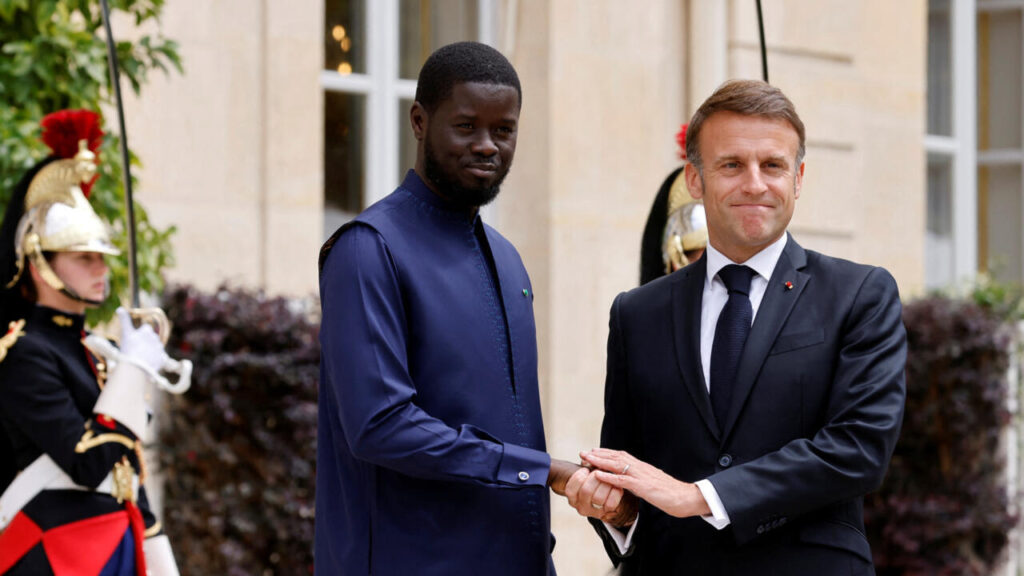
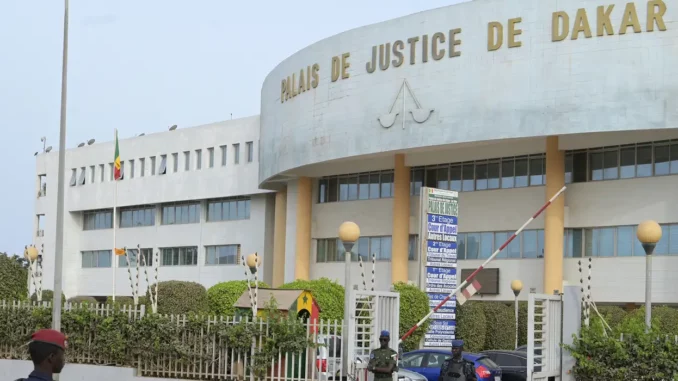
Senegal has “decided to suspend” all extraditions to France, Dakar’s justice minister said on Thursday, December 11, accusing Paris of refusing to hand over two Senegalese citizens to the West African country.
Yassine Fall, the Senegalese Justice Minister, announced this decision during a parliamentary address on Thursday.
She mentioned that Dakar has repeatedly sought the extradition of two individuals currently residing in France without success.
Consequently, the country will not extradite 12 individuals sought by France until it receives a positive response to its own requests from Paris.
“If these individuals have committed crimes, we will detain them. We do not follow France’s approach. We do not allow them to remain at liberty,” Fall stated.
The justice minister did not disclose the names of the two citizens in question, but this decision comes shortly after French courts postponed until February a ruling regarding the potential return of Madiambal Diagne, a Senegalese media tycoon and government critic.
Diagne is the subject of a Senegalese arrest warrant concerning alleged financial misconduct. French courts have asked for more information to decide on the country’s extradition request, which the government claims to have provided.
Diagne’s attorneys argued that Dakar’s decision constitutes “diplomatic blackmail.”
They signed an extradition agreement with France in 2021.
The Republic of Senegal is located at the westernmost point of West Africa, along the coast of the Atlantic Ocean. It shares its northern border with Mauritania, its eastern border with Mali, its southeastern border with Guinea, and its southwestern border with Guinea-Bissau. The nation is almost completely encircled by The Gambia, which is a narrow country situated along the Gambia River, separating the southern area of Casamance from the rest of the country.
Additionally, it has a maritime boundary with Cape Verde. Dakar serves as the capital and largest city of the country.
As the westernmost nation on the mainland of the Old World, or Afro-Eurasia, Senegal derives its name from the Senegal River that runs along its northern and eastern borders. The climate is predominantly Sahelian, characterized by a rainy season.
The country spans nearly 197,000 square kilometers (76,000 square miles) and is home to a population of approximately 18 million people. The nation operates as a presidential republic and has been recognized since its establishment in 1960 as one of the most stable countries in Africa. According to the 2024 V-Dem Democracy Indices, the country ranks 68th globally in electoral democracy and 10th in Africa.
Madagascar President Warns of Coup Attempt After Military Unit Defects
Elite troops participate in youth-led utility protests that have grown to pose the biggest challenge to President Andry Rajoelina’s administration. In Madagascar, a rebellious army unit supporting anti-government demonstrators has appointed a new military leader after President Andry Rajoelina condemned a “illegal attempt to seize power.”
Armed Forces Minister Manantsoa Deramasinjaka Rakotoarivelo was present at the event held at the military headquarters on Sunday to install General Demosthene Pikulas by the Army Personnel Administration Centre (CAPSAT).
At the event in Antananarivo, the minister declared, “I give him my blessing.”
The youth-led protesters on Saturday were joined by the elite CAPSAT army unit, which was a key player in the 2009 coup that initially installed Rajoelina.
“From now on, all orders of the Malagasy army – whether land, air, or [naval] – will originate from CAPSAT headquarters,” the contingent asserted in a video statement released early on Sunday.
The announcement was made just hours after the president claimed that unidentified forces were trying to topple Rajoelina. Without giving specifics, the president said in a statement that “an attempted illegal and forcible seizure of power” was occurring in the African country.
After the army ceremony in the capital, Pikulas admitted to journalists that events in Madagascar over the past few days had been “unpredictable”.
“So the army has a responsibility to restore calm and peace throughout Madagascar,” he said.
Asked about calls for Rajoelina to resign, he said he refused to “discuss politics within a military facility”.
On Saturday, military personnel from CAPSAT had urged their comrades to stop following orders and instead back the youth-led uprising.
“We have become boot lickers,” some members of the unit said in a video posted on social media. “We have chosen to submit and execute orders, even illegal ones, instead of protecting the population and their property.”
“Do not obey orders from your superiors. Point your weapons at those who order you to fire on your comrades in arms because they will not take care of our families if we die,” they said.
CAPSAT Colonel Michael Randrianirina said his unit’s decision to join the protesters did not amount to a coup. “We answered the people’s calls, but it wasn’t a coup d’etat,” he told reporters.
Prime Minister Ruphin Fortunat Zafisambo, a military general appointed after Rajoelina dismissed his predecessor under pressure from demonstrators, said the government was “fully ready to listen and engage in dialogue with all factions – youth, unions or the military”.
People on the streets of Antananarivo were pleased about the announcement, said Al Jazeera’s Fahmida Miller, reporting from the city’s Independence Square on Sunday.
“People here say that his dismissal is important because it could mean that Andry Rajoelina could leave office. We don’t know if that’s the case; it could be that the Senate is trying to appease Malagasies who have been out protesting on the streets,” she said, but added that this in addition to CAPSAT coming out in support of the protesters has given many hope.
“What we can say is that Madagascar is in crisis,” Miller said. “[But] people here are optimistic that there is change coming. They call it a revolution. People here have given Andry Rajoelina one day to leave office … They are demanding that he leave office, they are also demanding that he apologise for the people who have been killed [by security forces].”
Madagascar’s army has a long history of intervening in politics during crises. Since independence from France in 1960, it has backed or led several power shifts, including coups in the 1970s and in 2009, when it helped oust President Marc Ravalomanana and bring Antananarivo’s reformist mayor, Rajoelina, to power.
Though the military has stayed mostly in the background in recent years, it remains an influential force in the country’s often fragile political landscape.
When President Donald Trump and the President of South Africa met on May 21, 2025, the American president questioned Cyril Ramaphosa about a widely held accusation of white genocide in his nation.
Trump played footages in the room where the meeting was held with other top media companies present, the video showed South Africans chanting “kill the Boer, kill the farmer” and according to Mr. Trump, white farmers are fleeing South Africa.
Before the video was played live for the western media, President Trump asked the staff to dim the lights and play him a video that he claimed proved genocide was being committed against white people in South Africa, driving farmers to flee to the United States.
Julius Malema, a fiery far-left opposition lawmaker from South Africa, was shown singing “Kill the Boer, kill the farmer” in a four-minute film that was displayed on a giant screen. This infamous slogan originated during the apartheid era and was used to protest white-minority rule.
It concluded with pictures of a demonstration in South Africa where white crosses were erected alongside a rural road to symbolise farmers who had been killed, but which Trump said displayed their graves.
Watch the footage as Trump ambushes Ramaphosa.
Trump demande des comptes au président de l'Afrique du Sud Cyril Ramaphosa au sujet de tous ces fermiers blancs massacrés par milliers dans son pays depuis des décennies. Il lui montre la vidéo dans laquelle Julius Malema exhorte ses militants à tuer les Blancs : "kill the Boer". pic.twitter.com/xeToU6XX4A
Prime Minister Sonko of Senegal Meets President Ibrahim Traoré in Burkina Faso
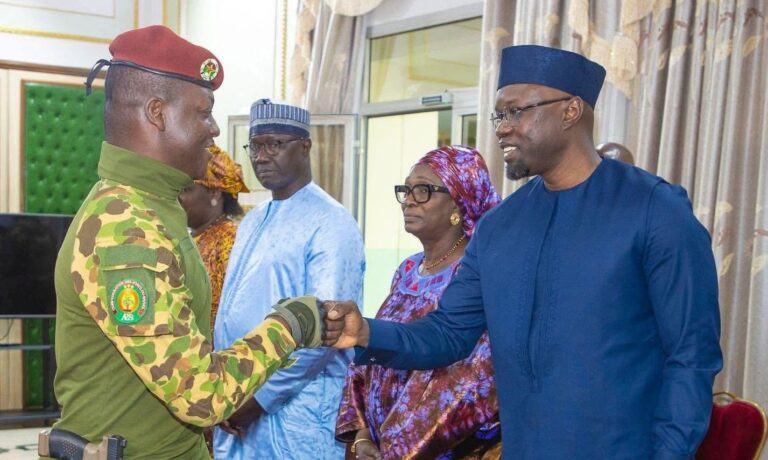
The Prime Minister of Senegalese, Ousmane Sonko payed a visit to the Burkina Faso, where Captain Ibrahim Traoré and the people of Burkina Faso warmly welcomed him into their country.
Prime Minister Sonko’s visit was about underscoring a growing effort to reinforce diplomatic and security cooperation between the two West African countries.
Sonko landed in Ouagadougou with senior officials, including the foreign and defence ministers of Senegal, according to the Senegalese Press Agency (APS).
Sonko spoke with President Ibrahim Traoré at the presidential palace after speaking with his Burkinabè colleague, Jean-Emmanuel Ouédraogo.
According to APS, the purpose of the trip is to give the junta government of Burkina Faso “political and moral support.” Since taking office in a military coup in 2022, President Traoré has been in charge of a transitional government.
His administration is still fighting increasing attacks by armed groups, such as those associated with Jama’at Nusrat al-Islam wal-Muslimin (JNIM), a coalition with ties to Al-Qaeda that operates throughout the Sahel.
The meeting between the two leaders is also seen as a response to what the junta described as “attempts at external destabilisation,” particularly pointing fingers at neighbouring Côte d’Ivoire. Given the shared challenges posed by jihadist insurgencies across the Sahel, both sides are expected to deepen their security collaboration.
This visit marks Prime Minister Sonko’s second diplomatic outreach to a member state of the Alliance of Sahel States (AES), following his trip to Mali in August 2024. The AES bloc—which includes Burkina Faso, Mali, and Niger—was established as a strategic alliance in response to mounting tensions with the Economic Community of West African States (ECOWAS), of which Senegal remains a member.
Sonko’s visit signals Dakar’s nuanced approach to diplomacy in the region, maintaining open dialogue with AES states despite differing stances within regional blocs.
The left-leaning South African political party known as the Economic Freedom Fighters (EFF) has vehemently denied recent accusations made by the U.S. Senate against Captain Ibrahim Traoré, the president of Burkina Faso.
The EFF has categorically denied the U.S. Senate’s charge that Traoré diverted Burkina Faso’s gold stockpiles for his own personal protection rather than for the benefit of his people during a hearing led by a representative of the U.S. Africa Command (AFRICOM).
This allegation has been condemned by the EFF as a clear imperialist ploy to topple an independent African state that is claiming sovereignty over its natural resources.
In a statement issued via its official X (formerly Twitter) account, the EFF stated: “We condemn the West’s continued interference in African nations’ affairs and their attempts to control our resources. The EFF supports Captain Traoré’s efforts to reclaim Burkina Faso’s gold for the benefit of its people and to resist neo-colonial pressures.”
The EFF described the U.S. allegations as part of a broader pattern of Western meddling in African governance, warning that such narratives are designed to delegitimize leaders who reject foreign domination.
Reaffirming its support for Traoré, the party praised his commitment to redirecting national gold revenues toward security and development goals.
The EFF emphasized that African countries must maintain the sovereign right to determine how their resources are utilized without external interference.
US AFRICOM’s statement on Burkina Faso
During a Senate Armed Services Committee hearing on April 3, 2025, General Michael Langley, Commander of the United States Africa Command (AFRICOM), delivered the Command’s 2025 posture statement, emphasizing the strategic importance of the African continent to U.S. national security.
While responding to a question from Senator Roger Wicker about corruption and bribery linked to trade with China, General Langley alleged that Burkina Faso’s mineral revenues, along with some financial flows from Chinese cooperation, were being used to sustain the ruling military regime, rather than benefiting the Burkinabè population.
“Absolutely, Chairman. I see this, and I don’t mind calling it out,” Langley said. “Captain [Ibrahim] Traoré in Burkina Faso… their gold reserves are just in exchange to protect the junta regime.”
Addressing broader concerns about Chinese and Russian influence in Africa, Langley stated that the Chinese Communist Party is seeking to use the continent as a platform to expand its global dominance, while Russia exploits instability and chaos to extend its reach.
“In order to protect our homeland and United States interests, we must deter these nations and their malign actors from their goals on the African continent,” he said
He was also promoted to the country’s highest military rank of army general, and signed a decree ordering that all political parties be dissolved.
During a ceremony in the capital, Niamey, Gen Tchiani said of his new military rank: “I receive this distinction with great humility… I will strive to live up to the trust placed in me.”
The transition to democratic rule is in line with recommendations that a commission made following national discussions.
This five-year time period is “flexible” depending on the country’s security status, the new charter says.
Niger has been plagued by jihadist attacks for many years – one of the issues junta leaders cited when staging their coup.
The military takeover followed a string of others in the region – neighbouring Mali, Guinea and Burkina Faso are also run by juntas.
All four countries have severed ties with former colonial power France and forged new alliances with Russia.
And all except Guinea, have pulled out of Ecowas, the West African regional bloc.
Niger’s relations with Ecowas broke down when the junta proposed a three-year transition period to democratic rule straight after the coup.
Ecowas called this plan a “provocation” and threatened to intervene with the use of force, before later backing down.
Gen Tchiani’s administration is prosecuting former President Bazoum on allegations of committing high treason and undermining national security.
Bazoum is still being held in the presidential palace with his wife, while his son was granted a provisional release last January.
According to state-run news agency ANP, Gen Tchiani said that Niger’s new charter was in line with traditional constitutions but also takes “unprecedented measures to protect our natural resources so that Nigeriens truly benefit from the exploitation of their wealth”.
After being fired from his position, former financial crime boss Baltasar Engonga is reportedly planning to produce a new sɛxtapɛ with over 1000 persons, including well-known celebrities, influential politicians, and young women.
Engonga, whose lɛakɛd sɛxtapɛs caused a stir on the internet, has now targeted Mrs. Bianca Odinaka Odumegwu-Ojukwu, the Nigerian Minister of State for Foreign Affairs, along with other well-known individuals included on the tape.
He expressed his wish when Engonga asked followers to provide more intimate details about the Nigerian minister in a remark beneath a picture of her.
The ex-ANIF director’s interest was apparently sparked by Bianca Odinaka’s appearance, with her striking skin tone and beauty catching his eye.
“Who is this fine lady?” Engonga commented, prompting social media users to speculate about his intentions, with some suggesting he aims to involve her in one of his new, yet-to-be-released videos. See his post below:
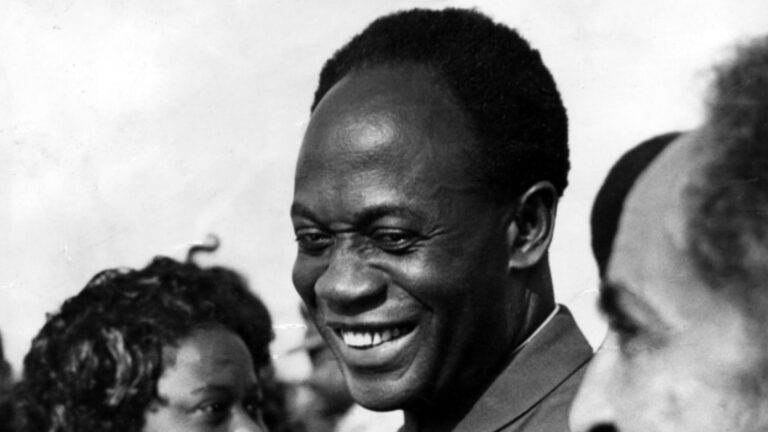
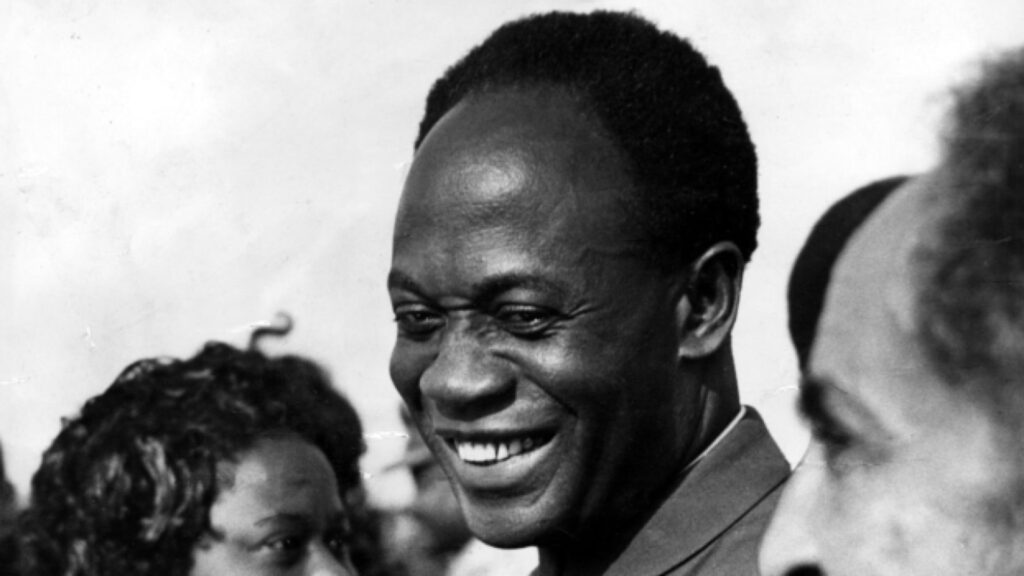
One of Africa’s most visionary leaders, Dr. Kwame Nkrumah was instrumental in Ghana’s development and the struggle for African independence.
The name Kwame Nkrumah is closely associated with Ghanaian history. Nkrumah was born in Nkroful, Gold Coast (now Ghana), on September 21, 1909. He went on to become Ghana’s first president and a significant player in the struggle for African independence.
7 Facts About Dr. Kwame Nkrumah
Focused on economic development
Nkrumah’s presidency was marked by a focus on economic development and social welfare, with initiatives such as the construction of schools, hospitals, and roads, as well as the establishment of a national airline and shipping line.
Nkrumah was also a vocal advocate for pan-Africanism, calling for unity among African nations to fight against imperialism and colonialism. He played a key role in the formation of the Organisation of African Unity (OAU), which aimed to promote cooperation and solidarity among African countries.
Thirst for knowledge
Nkrumah’s early life was marked by a thirst for knowledge and a passion for politics. He studied at the prestigious Achimota School and later went on to pursue higher education in the United States and the United Kingdom. It was during this time that Nkrumah became involved in the Pan-African movement, which sought to unify African nations and fight against colonial rule.
In 2000, he was voted African Man of the Millennium by listeners to the BBC World Service, being described by the BBC as a “Hero of Independence”, and an “International symbol of freedom as the leader of the first black African country to shake off the chains of colonial rule.”
Received honorary awards from five universities
Over his lifetime, Nkrumah was awarded honorary doctorates by many universities, including Lincoln University (Pennsylvania), Moscow State University (USSR), Cairo University (Egypt), Jagiellonian University (Poland) and Humboldt University (East Germany).
Alleged controversial rule
However, Nkrumah’s rule was not without controversy. His government was criticised for its authoritarian tendencies and the suppression of political dissent. In 1966, Nkrumah was overthrown in a military coup while on a state visit to China.
Despite his ousting, Nkrumah’s legacy as the founding father of Ghana and a champion of African independence remains strong. His vision of a united and prosperous Africa continues to inspire generations of leaders and activists across the continent.
His bride price to his wife’s family was rejected
Kwame Nkrumah married Fathia Ritzk, an Egyptian Coptic bank worker and former teacher, on the evening of her arrival in Ghana on New Year’s Eve, 1957–1958. Fathia’s mother refused to bless their marriage after another one of her children left with a foreign husband.
As a married couple, the Nkrumah family had three children: Gamal (born 1958), Samia (born 1960) and Sekou (born 1964). Gamal is a newspaper journalist, while Samia and Sekou are politicians. Nkrumah also has another son, Francis, a pediatrician (born in 1962). There may be another son, Onsy Anwar Nathan Kwame Nkrumah, born to an Egyptian mother and an additional daughter, Elizabeth. Onsy’s claim to be Nkrumah’s son is disputed by Nkrumah’s other children.
Nkrumah was honorary co-president of Guinea
Nkrumah’s government became authoritarian in the 1960s, as he repressed political opposition and conducted elections that were not free and fair. In 1964, a constitutional amendment made Ghana a one-party state, with Nkrumah as president for life of both the nation and its party. He fostered a personality cult, forming ideological institutes and adopting the title of ‘Osagyefo Dr.’, while adorning currency with his images. Nkrumah was deposed in 1966 by the National Liberation Council in a coup d’état, under whose supervision the country’s economy was privatised. Nkrumah lived the rest of his life in Guinea, where he was named honorary co-president.
Kwame Nkrumah’s legacy lives on in the hearts and minds of the Ghanaian people, as well as in the history books that document his remarkable life and achievements.